Cain's Ballroom
Details
- Date
- July 26, 2025
- Venue
- Cain's Ballroom Tulsa, Oklahoma
- Billed As
- The Million Dollar Bashers
- Gig Type
- Concert
- Guests
- Lee Ranaldo, Steve Shelley, John Doe, Nels Cline, Mikael Jorgensen, Robyn Hitchcock, Emma Swift and others
Notes
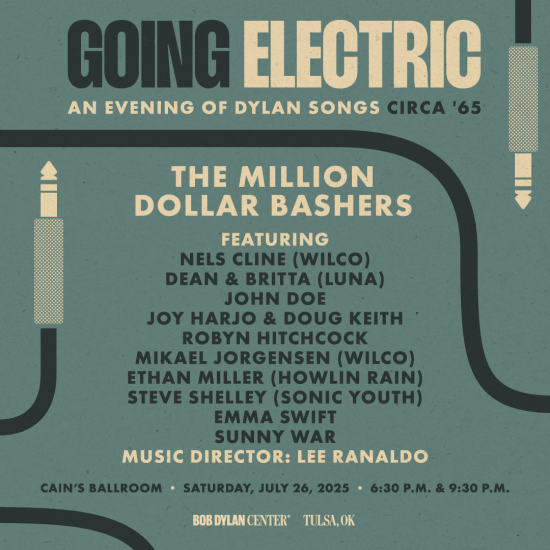
Going Electric: An Evening of Dylan Songs Circa ’65
The Bob Dylan Center will celebrate its newest exhibition, “Going Electric: Bob Dylan ’65,” with two special performances by The Million Dollar Bashers, featuring members of Sonic Youth, X, Wilco and more on July 26 at Cain’s Ballroom in Tulsa, Oklahoma.
The Million Dollar Bashers are an ad hoc supergroup featuring Lee Ranaldo and Steve Shelley of Sonic Youth; John Doe of X; Nels Cline and Mikael Jorgensen of Wilco; Ethan Miller of Howlin Rain; singer-songwriter Sunny War; three-time U.S. Poet Laureate and Bob Dylan Center artist-in-residence Joy Harjo, accompanied by Doug Keith; dream-pop duo Dean & Britta of Luna; singer-songwriter Robyn Hitchcock; and singer-songwriter Emma Swift. Ranaldo will serve as musical director for the evening.
Late standing show - 9:30pm
The Bob Dylan Center will celebrate its newest exhibition, “Going Electric: Bob Dylan ’65,” with two special performances by The Million Dollar Bashers, featuring members of Sonic Youth, X, Wilco and more on July 26 at Cain’s Ballroom in Tulsa, Oklahoma.
The Million Dollar Bashers are an ad hoc supergroup featuring Lee Ranaldo and Steve Shelley of Sonic Youth; John Doe of X; Nels Cline and Mikael Jorgensen of Wilco; Ethan Miller of Howlin Rain; singer-songwriter Sunny War; three-time U.S. Poet Laureate and Bob Dylan Center artist-in-residence Joy Harjo, accompanied by Doug Keith; dream-pop duo Dean & Britta of Luna; singer-songwriter Robyn Hitchcock; and singer-songwriter Emma Swift. Ranaldo will serve as musical director for the evening.
Late standing show - 9:30pm
Set List
- Most Likely You Go Your Way and I'll Go Mine Joy Harjo
- The Times They Are A-Changin' Emma Swift
- Mr. Tambourine Man Joy Harjo
- To Ramona John Doe, solo
- I'll Keep It With Mine Dean & Britta
- Subterranean Homesick Blues Sunny War
- She Belongs to Me Dean Wareham
- Maggie's Farm John Doe
- Love Minus Zero/No Limit Dean & Britta
- It's All Over Now, Baby Blue Joy Harjo
- Queen Jane Approximately Emma Swift
- Highway 61 Revisited Bob Dylan Robyn Hitchcock
- Desolation Row Bob Dylan Robyn Hitchcock
- I Want You Sunny War
- Just Like a Woman Dean & Britta
- Like a Rolling Stone Bob Dylan Everyone, Robyn & Emma lead on 2nd verse
Media
Clips of various songs from Instagram
Video by the Bob Dylan Center summarizing the whole weekend
Reviews
Extensive report, including pictures and videos, by 'Flagging Down the Double E's'
Hitchcock was the only performer to do his songs back-to-back, due to his two selections appearing two tracks apart on Highway 61 Revisited. He told me in both cases, he was trying to bring the songs back to their roots:
To me, the arrangements of both “Desolation Row” and “Highway 61” on the record are definitive. So if I do them live, I’m just trying to put them in that way. I’m not trying to do them in a new way. That’s for Dylan to mess up. My role if I try and do Dylan songs is to do it as close to the feel of the original as possible. Like if you were playing a piece of classical music, you would try and get it right. Do it like Bach did it, or how we think Bach did it, rather than “Well, we’re taking the bones of this and then we’re kind of reinterpreting it,” you know?
For “Desolation Row,” freezing it in time meant enlisted Cline to approximate Charlie McCoy’s inimitable guitar lines and Miller to channel Russ Savakus’ moving bass. Miller said, “My special moment with that was in rehearsal stripping it down after all of us making a racket trying to figure everything out. There is this hushed moment where me and Nels are playing with Robyn, Lee a little bit too. Even though we’re all playing and flowing for 12 minutes, you’re really living inside those lyrics and that song.”
Hitchcock explained what the song means to him:
“Desolation Row” is just a magic song. It’s certainly one of his peaks. He wrote some great songs afterwards, after the crash, very emotionally intense songs, and still does sometimes, but he’s never produced anything like that. And nobody else has. I heard that when I was just turning 13, and it was one of the things that tipped me into doing what I’ve done.
He told me his feelings about “Highway 61” too:
It’s that little window where Dylan was very exhilarating. He was complaining—you know, he’s always been a ketch—but he was complaining in such an exciting way that it it was almost a celebration. So you’ve got all these kind of malfunctioning human scenarios and they’re all set on Highway 61. The whole human catastrophe is spelt out there in all its grotesque absurdity.
Hitchcock said it’s easy for “Highway 61” to devolve into a “colorless boogie.” To avoid that, he enlisted three key players: Jorgensen to do the distinct keyboard flourish that starts the Highway 61 version, Cline to channel Mike Bloomfield’s slide guitar, and, most importantly, Ranaldo on toy siren. This was, in fact, the exact same type of siren Dylan used on the original. Ranaldo acquired it when the Bashers originally recorded this song with Karen O on vocals for the I’m Not There soundtrack. “It comes in this little beautiful box, it’s made in England, it’s a fine-honed piece of machinery,” he said.
Online review by Americana Highways
It’s been a good year to be a Dylan fan in Tulsa. Earlier this spring, Bob himself performed over at the Tulsa Theater, and earlier last week, The Bob Dylan Center opened its newest exhibition Going Electric: Dylan ’65, which is a look at Dylan’s most transformative year. The new exhibition is presented by The Bob Dylan Center’s Founding Members Bob and Debbie Russell and timed with the 60th anniversary of Dylan’s July 25th Newport Folk Festival, and the cultural upheaval that followed.
To celebrate, The Bob Dylan Center presented two special performances by the Million Dollar Bashers on Saturday evening, just around the corner at the legendary Cain’s Ballroom. The Bashers, with their name lifted from the 1967 song “Million Dollar Bash” that was released on 1975’s The Basement Tapes, are an ad-hoc supergroup comprised of Lee Ranaldo and Steve Shelley of Sonic Youth, Nels Cline and Mikael Jorgensen of Wilco, John Doe of X, singer-songwriter Robyn Hitchcock, Ethan Miller of Howling Rain, singer-songwriter Sunny War, Britta Phillips and Dean Wareham of Dean & Britta/Luna, singer-songwriter Emma Swift, jack-of -all trades Chebon Tiger, and three time U.S. Poet Laureate and Bob Dylan Center resident artist, Joy Harjo who was accompanied by Doug Keith on guitar. Ranaldo also served as the evening’s musical director.
The band originally came to be around the release of the 2007 Dylan biopic “I’m Not There” and its accompanying soundtrack. More a companion to the film rather than a proper soundtrack, it features a single Dylan track ( the title track) with the remainder a collection of artists such as Willie Nelson, Eddie Vedder, Jeff Tweedy and more, performing songs from Dylan’s vast catalog. It’s a wonderful album that I always recommend. For me, the most intriguing tracks were ones featuring a band called the Million Dollar Bashers. The band at that time included a host of the same players as tonight, Lee Ranaldo, Steve Shelley, Nels Cline as well as featuring Dylan bassist Tony Garnier, guitarist Smokey Hormel, John Medeski and the late Tom Verlaine of Television.
Tonight’s performances were split into two sets, with an early, seated 6:30pm performance that was followed by a standing room, 9:30pm set. Each set opened with an introduction from Bob Dylan Center Executive Director, Steven Jenkins, before musical director extraordinaire Lee Ranaldo and his fellow Bashers kicked things off with a righteous romp through “Most Likely You Go Your Way and I’ll Go Mine.” From there, the Bashers served as house band with Ranaldo on guitar and backed by his Sonic Youth bandmate and longtime musical collaborator Steve Shelley on drums. There were also Wilco bandmates, with Nels Cline on guitar and Mikael Jorgensen on keys, and they were rounded out by Howling Rain’s Ethan Miller on bass and Oklahoma’s own, Chebon Tiger on harmonica. Over the course of the sets, Ranaldo welcomed a guest who went on to perform a song or songs with variations of the band accompanying. I’ve included the setlist and performers below.:
I enjoyed each performance, and found highlights throughout. From Robyn Hitchcock’s fiery takes on “Highway 61 Revisited” and “Desolation Row,” John Doe‘s haunting “To Ramona” and blistering “Maggie’s Farm.” Sunny War boldly and successfully took on the machine gun cadence’s of “Subterranean Homesick Blues” and “I Want You.” Joy Harjo’s take on “Mr. Tambourine Man” and “It’s All Over Now, Baby Blue” came with a Patti Smith-like ferocity accompanied by Doug Keith’s tasteful fills and Harjo’s saxophone. Britta Phillips and Dean Wareham added a more atmospheric state with their takes both solo and collectively of “I’ll Keep it With Mine,” “She Belongs to Me” “Love Minus Zero/No Limit” and “Just Like a Woman.” Finally, it was Emma Swift’s impeccable selections of “The Times They Are a-Changing” and “Queen Jane Approximately” that seemed perfectly themed to the event’s anniversary.
I think I was most excited overall just watching the band and feature artists interact. It all seemed so genuine. I’m a big fan of Sonic Youth. I was one of those people that first saw them when they opened for Neil Young, and actually liked it. A chance to see Ranaldo and Shelley like this was a dream come true. I’m also excited about an upcoming project from Shelley and Ethan Miller who are teaming up with guitarist Bill Orcutt for Orcutt Shelley Miller a self-titled debut album via Miller’s Silver Current Records, so watching those two collaborate was fascinating It was also a treat seeing Nels Cline and Mikael Jorgensen share that space with all these other musicians adding perfect fill after perfect fill. Finally, local guitar bad-ass Chebon Tiger played the role of last minute hero, filling in on harmonica throughout the night on the recommendation of John Fullbright.
I know a lot of work went into these performances, and for it to have been as successful as it was, that was no easy task. I know the artists trickled into town early for rehearsals, and I’m sure there were some red eye flights in and out. Getting all of that coordinated and arranged sounds like a nightmare, so a tip of the hat there. The thing is, it worked. There were a couple of missed cues, a few flubs, but it was remarkably good and again, absolutely genuine. The first set, a seated show seemed a bit more reserved and intimate, while the second SRO performance was understandably more relaxed and confident. As a whole, it exceeded every expectation I’d had. I just can’t imagine that I’ll ever see such an immensely talented and passionate ensemble of artists performing anything like this again. Each set ended with the entire ensemble filling the stage, acknowledging the significance and then, “The snare drum snap that was heard ’round the world” that signals “Like a Rolling Stone” to wrap up the evening.
Hitchcock was the only performer to do his songs back-to-back, due to his two selections appearing two tracks apart on Highway 61 Revisited. He told me in both cases, he was trying to bring the songs back to their roots:
To me, the arrangements of both “Desolation Row” and “Highway 61” on the record are definitive. So if I do them live, I’m just trying to put them in that way. I’m not trying to do them in a new way. That’s for Dylan to mess up. My role if I try and do Dylan songs is to do it as close to the feel of the original as possible. Like if you were playing a piece of classical music, you would try and get it right. Do it like Bach did it, or how we think Bach did it, rather than “Well, we’re taking the bones of this and then we’re kind of reinterpreting it,” you know?
For “Desolation Row,” freezing it in time meant enlisted Cline to approximate Charlie McCoy’s inimitable guitar lines and Miller to channel Russ Savakus’ moving bass. Miller said, “My special moment with that was in rehearsal stripping it down after all of us making a racket trying to figure everything out. There is this hushed moment where me and Nels are playing with Robyn, Lee a little bit too. Even though we’re all playing and flowing for 12 minutes, you’re really living inside those lyrics and that song.”
Hitchcock explained what the song means to him:
“Desolation Row” is just a magic song. It’s certainly one of his peaks. He wrote some great songs afterwards, after the crash, very emotionally intense songs, and still does sometimes, but he’s never produced anything like that. And nobody else has. I heard that when I was just turning 13, and it was one of the things that tipped me into doing what I’ve done.
He told me his feelings about “Highway 61” too:
It’s that little window where Dylan was very exhilarating. He was complaining—you know, he’s always been a ketch—but he was complaining in such an exciting way that it it was almost a celebration. So you’ve got all these kind of malfunctioning human scenarios and they’re all set on Highway 61. The whole human catastrophe is spelt out there in all its grotesque absurdity.
Hitchcock said it’s easy for “Highway 61” to devolve into a “colorless boogie.” To avoid that, he enlisted three key players: Jorgensen to do the distinct keyboard flourish that starts the Highway 61 version, Cline to channel Mike Bloomfield’s slide guitar, and, most importantly, Ranaldo on toy siren. This was, in fact, the exact same type of siren Dylan used on the original. Ranaldo acquired it when the Bashers originally recorded this song with Karen O on vocals for the I’m Not There soundtrack. “It comes in this little beautiful box, it’s made in England, it’s a fine-honed piece of machinery,” he said.
Online review by Americana Highways
It’s been a good year to be a Dylan fan in Tulsa. Earlier this spring, Bob himself performed over at the Tulsa Theater, and earlier last week, The Bob Dylan Center opened its newest exhibition Going Electric: Dylan ’65, which is a look at Dylan’s most transformative year. The new exhibition is presented by The Bob Dylan Center’s Founding Members Bob and Debbie Russell and timed with the 60th anniversary of Dylan’s July 25th Newport Folk Festival, and the cultural upheaval that followed.
To celebrate, The Bob Dylan Center presented two special performances by the Million Dollar Bashers on Saturday evening, just around the corner at the legendary Cain’s Ballroom. The Bashers, with their name lifted from the 1967 song “Million Dollar Bash” that was released on 1975’s The Basement Tapes, are an ad-hoc supergroup comprised of Lee Ranaldo and Steve Shelley of Sonic Youth, Nels Cline and Mikael Jorgensen of Wilco, John Doe of X, singer-songwriter Robyn Hitchcock, Ethan Miller of Howling Rain, singer-songwriter Sunny War, Britta Phillips and Dean Wareham of Dean & Britta/Luna, singer-songwriter Emma Swift, jack-of -all trades Chebon Tiger, and three time U.S. Poet Laureate and Bob Dylan Center resident artist, Joy Harjo who was accompanied by Doug Keith on guitar. Ranaldo also served as the evening’s musical director.
The band originally came to be around the release of the 2007 Dylan biopic “I’m Not There” and its accompanying soundtrack. More a companion to the film rather than a proper soundtrack, it features a single Dylan track ( the title track) with the remainder a collection of artists such as Willie Nelson, Eddie Vedder, Jeff Tweedy and more, performing songs from Dylan’s vast catalog. It’s a wonderful album that I always recommend. For me, the most intriguing tracks were ones featuring a band called the Million Dollar Bashers. The band at that time included a host of the same players as tonight, Lee Ranaldo, Steve Shelley, Nels Cline as well as featuring Dylan bassist Tony Garnier, guitarist Smokey Hormel, John Medeski and the late Tom Verlaine of Television.
Tonight’s performances were split into two sets, with an early, seated 6:30pm performance that was followed by a standing room, 9:30pm set. Each set opened with an introduction from Bob Dylan Center Executive Director, Steven Jenkins, before musical director extraordinaire Lee Ranaldo and his fellow Bashers kicked things off with a righteous romp through “Most Likely You Go Your Way and I’ll Go Mine.” From there, the Bashers served as house band with Ranaldo on guitar and backed by his Sonic Youth bandmate and longtime musical collaborator Steve Shelley on drums. There were also Wilco bandmates, with Nels Cline on guitar and Mikael Jorgensen on keys, and they were rounded out by Howling Rain’s Ethan Miller on bass and Oklahoma’s own, Chebon Tiger on harmonica. Over the course of the sets, Ranaldo welcomed a guest who went on to perform a song or songs with variations of the band accompanying. I’ve included the setlist and performers below.:
I enjoyed each performance, and found highlights throughout. From Robyn Hitchcock’s fiery takes on “Highway 61 Revisited” and “Desolation Row,” John Doe‘s haunting “To Ramona” and blistering “Maggie’s Farm.” Sunny War boldly and successfully took on the machine gun cadence’s of “Subterranean Homesick Blues” and “I Want You.” Joy Harjo’s take on “Mr. Tambourine Man” and “It’s All Over Now, Baby Blue” came with a Patti Smith-like ferocity accompanied by Doug Keith’s tasteful fills and Harjo’s saxophone. Britta Phillips and Dean Wareham added a more atmospheric state with their takes both solo and collectively of “I’ll Keep it With Mine,” “She Belongs to Me” “Love Minus Zero/No Limit” and “Just Like a Woman.” Finally, it was Emma Swift’s impeccable selections of “The Times They Are a-Changing” and “Queen Jane Approximately” that seemed perfectly themed to the event’s anniversary.
I think I was most excited overall just watching the band and feature artists interact. It all seemed so genuine. I’m a big fan of Sonic Youth. I was one of those people that first saw them when they opened for Neil Young, and actually liked it. A chance to see Ranaldo and Shelley like this was a dream come true. I’m also excited about an upcoming project from Shelley and Ethan Miller who are teaming up with guitarist Bill Orcutt for Orcutt Shelley Miller a self-titled debut album via Miller’s Silver Current Records, so watching those two collaborate was fascinating It was also a treat seeing Nels Cline and Mikael Jorgensen share that space with all these other musicians adding perfect fill after perfect fill. Finally, local guitar bad-ass Chebon Tiger played the role of last minute hero, filling in on harmonica throughout the night on the recommendation of John Fullbright.
I know a lot of work went into these performances, and for it to have been as successful as it was, that was no easy task. I know the artists trickled into town early for rehearsals, and I’m sure there were some red eye flights in and out. Getting all of that coordinated and arranged sounds like a nightmare, so a tip of the hat there. The thing is, it worked. There were a couple of missed cues, a few flubs, but it was remarkably good and again, absolutely genuine. The first set, a seated show seemed a bit more reserved and intimate, while the second SRO performance was understandably more relaxed and confident. As a whole, it exceeded every expectation I’d had. I just can’t imagine that I’ll ever see such an immensely talented and passionate ensemble of artists performing anything like this again. Each set ended with the entire ensemble filling the stage, acknowledging the significance and then, “The snare drum snap that was heard ’round the world” that signals “Like a Rolling Stone” to wrap up the evening.